Never forget an important medication.
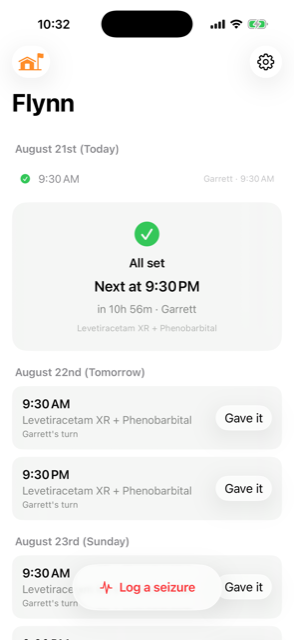
Most reminders buzz once and stop. This one doesn't stop until somebody says the dose was given.
Private beta. iPhone.1
Most reminders buzz once and stop. This one doesn't stop until somebody says the dose was given.
Private beta. iPhone.1
That's the part these apps get wrong. They assume the problem is memory, so they tell you once and consider themselves finished. Ask somebody who has actually missed a dose what happened and "I forgot" is almost never the answer.
One notification, one device, one attempt. It arrives during a meeting, a shower, a school run, and the software has done everything it intends to do while the dose has not happened. Nobody else was ever involved.
And when somebody else can give it, that becomes its own way to lose one. Two people each assuming the other had already done it is the most common way a dose goes missing in a house.
"I think so" is the honest answer most nights, and "I think so" is what ends up in front of the doctor at the appointment that was supposed to change something.
Every dose has a name on it before it comes due. Most of the time that name is yours. If there's somebody else, it reaches them next — and if there isn't, it comes back to you rather than reaching nobody.
Those are the defaults. You can retime the rungs, add your own, or change how loud each one is — the ladder is never allowed to be empty.
Nothing goes quiet until a person says they gave it. Your own medication, your kid's, your mother's, the dog's — whoever needs it, gets it.2
Opening an app to record something you've already done is how a record stops being accurate. So you never have to.
Gave it is on the alert itself. The app never opens, and every other phone stops asking.
A widget with the next dose, its time and whose turn it is — and the button, right on the face of it.
The same dose in the shapes that sit around the clock. Answered on a phone nobody has unlocked.
A button you can put where your thumb already goes — including the Action Button on the side of the phone.
“Flynn got his meds” is a complete instruction. Hands full, phone in another room.
A tag on the bottle records the dose when the phone touches it. No unlocking, no typing.3
A sitter, a school office, a home health aide, the neighbour with a key. Send a link and they get the doses, your emergency instructions and a number to call — with nothing to install and nothing to sign in to.4
What they open
Every turn inside that window goes to whoever's still home — the whole trip at once, not one dose at a time. Back on Thursday instead of Friday? One tap ends it early.
A tool people feel watched by is a tool that quietly gets lied to, and an inaccurate medication record is worse than none at all. So there is nothing here to feel watched by. This is engineering, not manners.
No streaks, no compliance percentage, no per-person statistics. The dose is the subject, never the person.
Home or out is worked out on the phone, and home or out is all that is ever recorded. No coordinates, no history, no map.5
Sign in with Apple, and nothing else. No password to make, no email to confirm. Whoever covers for you signs in to nothing at all.
Tomorrow is measured from the last dose actually given, not from a calendar — so the interval stays right when one runs late.
Reach for it in the same minute and one of you wins. The other is told who, before the second dose goes in.
Export a PDF of every medication and every dose recorded against it. It lists doses, not people.
It asks which before it asks anything else, then says doctor or vet for as long as you use it. Same app, your words.
A seizure is not the moment for a form. One tap starts a timer, one ends it, and it stays on the Lock Screen while your hands are full.
Archiving a medication ends its doses and keeps its history, marked stopped. Deleting is a different button that says what it takes.
The same app underneath: the dose gets given, or the phone keeps going until somebody says it did. What changes between these four is who else is around — not how any of it works.
One schedule and nobody behind it. There is no one else for it to reach, so it comes back to you instead of going quiet.
A kid's tablet before school, your mother's, the dog's, your own. More than one of you can give it, which is what makes it possible for nobody to.
They live somewhere else. You want to know the dose happened without asking them to account for themselves.
Somebody hands over a bag of pills and a set of instructions. Open a link, tap once. No app, no account.
It's in private testing. There is nowhere to download it yet.
Being built now, in roughly this order. Nothing here is on the rest of this page yet, and we'd rather say so than let you find out.