On your own
A reminder you swipe away at a red light is a dose that didn't happen. When you are the only person on the schedule, nothing behind that swipe notices — the notification has already done its job as far as the phone is concerned, and the next thing that asks is the bottle, twelve hours later.
So it doesn't stop at one buzz. With nobody else to pass it to, it keeps coming back to you, getting louder, until you actually answer it — because the alternative is that the loud end of this is the part you never get.
The obvious shortcut — a ladder that hands off to somebody else, and quietly does nothing when there is nobody else — would mean the loud rungs are exactly the ones a solo household never gets. That's backwards. With nobody to escalate to, it escalates to you.
Those are the defaults. You can retime the rungs, add your own, or change how loud each one is — the ladder is never allowed to be empty.
Every other app in this category answers a solo user with a number: a streak, a percentage, a ring to close. It works for a while and then you have a bad fortnight, and the number becomes a thing you don't want to look at — so you stop opening it, or you start entering doses you didn't take. The number was never measuring adherence. It was measuring how comfortable you still felt being honest with an app.
An inaccurate record is worse than no record. There are no streaks here, no compliance rate, and no statistics about you — not now, not later. The dose is the subject, never the person taking it.
Your phone arms the next two days of rungs on itself and tops them back up in the background. There is no server in the path between the dose time and the alarm. Offline you get a reminder you didn't need, never a missed one.
Tomorrow is measured from the last dose actually taken, not from a calendar. Take it three hours late and everything after it shifts, so the gap between doses stays right rather than snapping back and landing two doses close together.
Each medication has a never-sooner-than of its own. The schedule can't put a dose inside it, and reaching for one early gets you a plain sentence about when the last one was — not a lecture.
Setup asks whether the medication is for a person or an animal before it asks anything else, and then says doctor or vet, emergency room or emergency clinic, for the rest of the time you use it. It only changes wording. You can change the answer later.
Export a PDF of the medications and every dose recorded against them: the time each was due, the time it was taken, anything partial, refused or skipped and why. It notes plainly that a gap is a dose with nothing recorded, not a dose confirmed missed.
Coming off a medication archives it: it schedules nothing and sounds no alarms, and every dose already recorded stays in the history and in the export, marked stopped. Deleting is the other button, and it says what it takes with it.
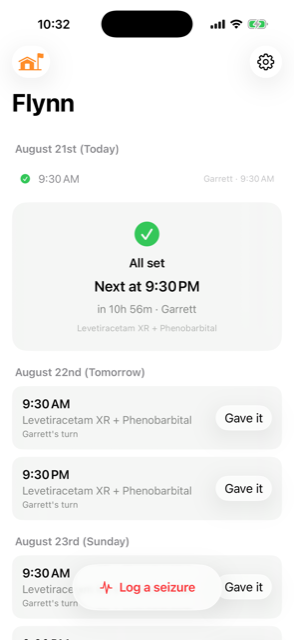
Nothing has to be rebuilt. You send a six-character code, they sign in with Apple, and the same schedule picks up a second phone — the rungs that were coming back to you start reaching them instead. Most people who need this end up needing it with somebody, eventually. That's the family version.
What it does underneath doesn't change. The problem it is pointed at does.
A kid's tablet before school, your mother's, the dog's, your own. More than one of you can give it, which is what makes it possible for nobody to.
They live somewhere else. You want to know the dose happened without asking them to account for themselves.
Somebody hands over a bag of pills and a set of instructions. Open a link, tap once. No app, no account.
It's in private testing. There is nowhere to download it yet.