Caring for a parent
You live somewhere else. The only tool you have is a phone call, and both of you can hear the real question inside it — so you ask about the weather instead, and hang up knowing nothing, and worry about it on the drive to work.
The alternative most apps offer is worse: a dashboard about your mother. Flynn is built so that the thing you can see is the dose, and there is nothing to see about the person taking it. You are not watching her. You are the phone it rings if hers goes unanswered, and most days it never gets that far.
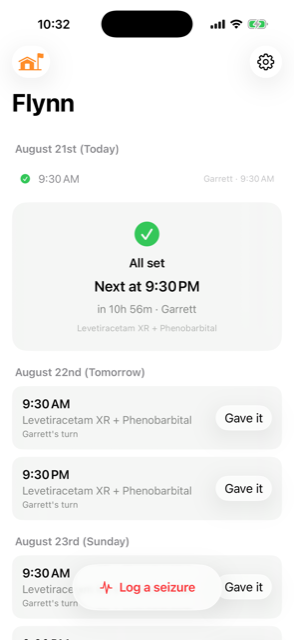
This matters more here than anywhere else. If your phone lights up at the same moment as theirs, you have taken the job off them and made yourself an alarm clock in another city. So the dose is theirs, and it stays theirs until reaching them has genuinely failed.
Those are the defaults. You can retime the rungs, add your own, or change how loud each one is — the ladder is never allowed to be empty.
And you can take a dose without taking it over for good: tap I've got this one when you're visiting, and the record reads Mum's turn · you took it. It never silently becomes yours from then on.
A compliance percentage about your mother is a document about her competence, and everybody in the family knows what it would eventually be used for. It does not exist here. Not hidden, not off by default — never collected.
What the app records is that a dose happened and, inside the household, who confirmed it. There are no per-person statistics, no streaks, no trend line, and nothing that could be screenshotted and sent to a sibling as evidence.
The point is not to be gentle about it. It is that a tool people feel watched by is one they quietly stop telling the truth to, and an inaccurate record is worse than no record at all.
Setup asks whether the medication is for a person or an animal before it asks anything else. Answer person and the app says doctor, emergency room, doctor's office, for as long as you use it. It changes only wording — the machinery underneath is identical, which is exactly why the words have to be right.
Everyone who joins sees the same schedule and can confirm any dose. Adding somebody is a six-character code read down the phone, or a link. Nobody has to be the one who owns the spreadsheet.
Export a PDF of the medications and every dose recorded against them — due time, actual time, anything partial, refused or skipped, and the reason. It lists doses, not people: what a doctor reads is what happened, not who was holding the bottle.
A home aide, a neighbour, a sibling staying the week: send a care link and they get a web page with the doses and one button. No app, no account, nothing to install. You switch it off when you're back.
Tomorrow is measured from the last dose actually taken, not from a calendar. A dose taken two hours late shifts the ones after it, so the interval stays right — and a per-medication floor keeps the schedule from putting two too close together.
Every rung is armed on the phone itself, two days ahead. A parent with patchy signal, or a phone that has been in aeroplane mode since a flight in March, still gets the alarm at the right minute.
What it does underneath doesn't change. The problem it is pointed at does.
One schedule and nobody behind it. There is no one else for it to reach, so it comes back to you instead of going quiet.
A kid's tablet before school, your mother's, the dog's, your own. More than one of you can give it, which is what makes it possible for nobody to.
Somebody hands over a bag of pills and a set of instructions. Open a link, tap once. No app, no account.
It's in private testing. There is nowhere to download it yet.