With your family

The dose nobody gave is the one you both thought was done.

Nobody forgets a dose that is clearly theirs. They miss the one they assumed had already been given — and the more people who care, the easier that assumption is to make. Two adults, a teenager who helps at weekends, a grandparent staying for a fortnight. Everyone is responsible, so at 9:30 nobody is. Which is why every dose here has a name on it before it comes due.

Whose medication it is matters less than you would think. Your son's ADHD tablet before school, your daughter's antibiotics twice a day for ten days, your mother's blood pressure pills, the dog's, your own. What they have in common is that more than one person could give it — which is exactly what makes it possible for nobody to.

So every dose has a name on it before it comes due, and whoever is holding the bottle can take it instead without the schedule quietly rewriting itself around them.
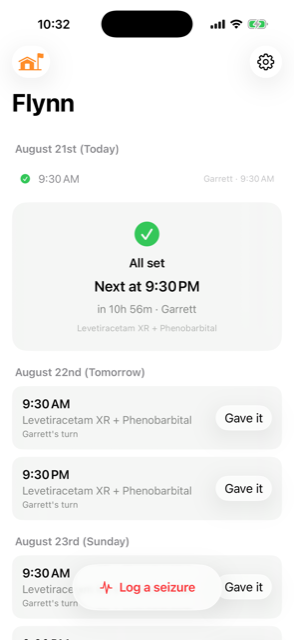
Tomorrow's doses, each labelled with whose turn it is and a button reading Gave it

Turns, and a way out of your turn.

A rota only helps if it survives real life, and real life is one of you being on a train.

Every dose has a name on it

Each dose time belongs to somebody — the morning is one of you, the evening is the other, and you can pin a slot to a particular person by hand. Tomorrow's doses already say whose they are, so a dose is something one person is expecting rather than something everybody hopes somebody noticed.

"I've got this one"

Take a dose that wasn't yours and the record keeps both names — it reads Molly's turn · Garrett took it, and never quietly becomes Garrett's all along. It is one dose handed over, not an edit to every dose after it, and there is a button to hand it back.

Answer without opening it

The notification itself carries Gave it and I'm on it — neither one launches the app. Confirm on any phone and every other phone stops asking. If you both reach for the bottle in the same minute, one of you wins and the other is told who, before the second dose goes in.

It exhausts one person before it wakes the house.

An app that alarms everybody at once is one everybody learns to ignore. Whoever the dose belongs to gets three goes, getting louder each time. Only when reaching them has genuinely failed does anybody else hear anything — which is what makes the last rung mean something when it arrives at midnight.

  1. Dose time A sound on the phone of whoever's turn it is. Nobody else is disturbed.
  2. +5 minutes The same again, still only them.
  3. +10 minutes An alarm on their phone. It breaks the silent switch and it breaks Focus.
  4. +20 minutes Now everybody's phone, alarm included. By this point it has earned it.

Those are the defaults. You can retime the rungs, add your own, or change how loud each one is — the ladder is never allowed to be empty.

There is nothing here to have an argument with.

The most dangerous thing a shared medication app can do is become evidence. This one has no per-person statistics to produce, because they were never collected.

Nobody is keeping score

No streaks. No compliance percentage. No per-person statistics, ever. The dose is the subject, never the person. There is no screen you can open at the end of a bad week to prove you did more of them.

Adding someone takes a code

Six characters, read down the phone or sent as a link. It uses only 0–9 and A–F, so there is no O to mistake for a zero when somebody is reading it out from the kitchen. It works once and expires in a week.

Going out is a state, not a date

Send a sitter a care link and it runs until you turn it off on the way back through the door, rather than until a time you had to guess at on Thursday. Get delayed and it is still working.

The schedule follows the dose

Tomorrow is measured from the last dose actually given, not from a calendar. Give it late and everything after it shifts, so the interval between doses stays right — and a minimum gap stops a late dose and an on-time one from landing on top of each other.

It works with no signal

Each phone arms the next two days of rungs on itself, and tops them back up in the background. The network makes it smarter — it isn't what makes it work. Offline you get a reminder you didn't need, never a missed one.

One record, for the appointment

Export the medications and every dose recorded against them as a PDF to hand across a counter. It lists the doses — the time due, the time given, anything skipped and why. It does not list who gave them.

The same app, from somewhere else.

What it does underneath doesn't change. The problem it is pointed at does.

It's in private testing. There is nowhere to download it yet.